
The Myth of Certainty
Every generation thinks its world is permanent—until history proves otherwise.

The first time I came across the photograph below, its origin story blew me away. Taken on May 20, 1910, at the funeral of King Edward VII of Great Britain, the image of nine reigning monarchs standing shoulder to shoulder captures one of the most remarkable moments in modern history.
The photograph, now known simply as “The Kings’ Gathering,” remains unique: never before or since have so many reigning European monarchs been captured together in a single image.
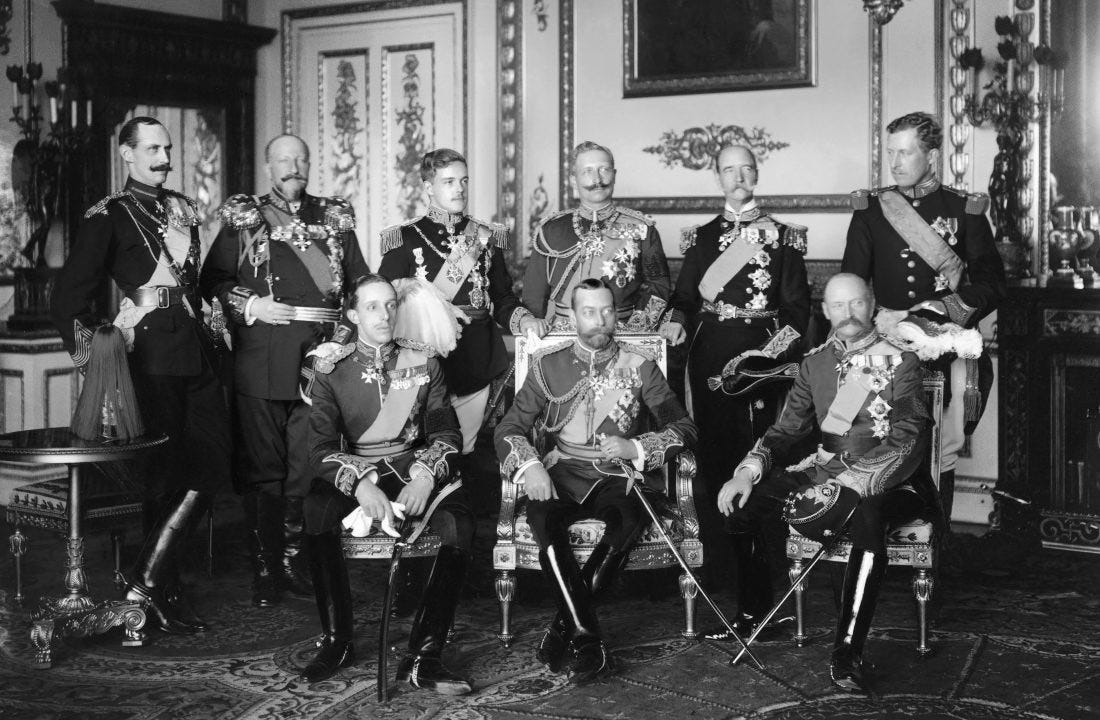
These are the men who ruled empires that stretched across the globe. Their navies controlled the seas, and their collective armies represented the greatest concentration of military power the world had ever known.
At first glance, it almost looks like a family portrait. In many ways, it was. Most of the men were related by blood: cousins, brothers-in-law, nephews, uncles, and grandchildren, descended either from Queen Victoria or King Christian IX of Denmark—earning the two the nicknames “the Grandmother of Europe” and “the Father-in-Law of Europe.”
Looking at this photograph, it’s difficult to imagine a more secure ruling class. Yet history has a way of humbling certainty. Just four years later, Europe descended into World War I. By the war’s end:
Tsar Nicholas II had been overthrown and executed along with his family.
Kaiser Wilhelm II had abdicated and fled into exile in the Netherlands.
The German Empire had ceased to exist.
The Austro-Hungarian Empire had collapsed.
The Russian Empire was gone.
The Ottoman Empire, allied with Germany, was in its final days.
Portugal’s young King Manuel II had already lost his throne in the revolution of 1910 and would spend the rest of his life in exile.
Others survived—and endured. King George V remained on the British throne through two world wars, helping transform the monarchy into the constitutional institution it remains today. King Albert became a national hero for refusing to surrender Belgium despite the German invasion.
King Haakon VII became one of Norway’s most beloved monarchs and later a symbol of resistance during World War II. King Alfonso XIII survived the Great War because Spain remained neutral, though he would eventually lose his throne in 1931. King Ferdinand I of Bulgaria abdicated after his country’s defeat in 1918.
The extraordinary thing about this photograph isn’t simply that these men were related. It’s that nearly everyone looking at this image in 1910 would have assumed they were looking at the permanent political order of Europe.
Within a decade, half of that world had disappeared. History rarely announces an era’s end; it just ends. And by the time most of us notice the paradigm has shifted, it’s too late.
That’s why I keep coming back to this photograph.
It’s a reminder that the institutions, markets, governments, and power structures we assume are permanent often look their strongest right before history decides otherwise. We like to think we’re different from the people who looked at this photograph in 1910—but are we?
Many of us assume the US dollar will permanently dominate global finance and that today’s technology giants will forever lead the market. We take for granted that America’s political institutions, global supply chains, and international alliances are set in stone. I’m sure the people in this photograph believed the same thing about their world.
But history had other plans.
